


What Is Agentic Screening? What Happens When AI Does the First Round of Hiring
Read Time
10 Minutes
Updated On
August 28, 2026
.jpeg)
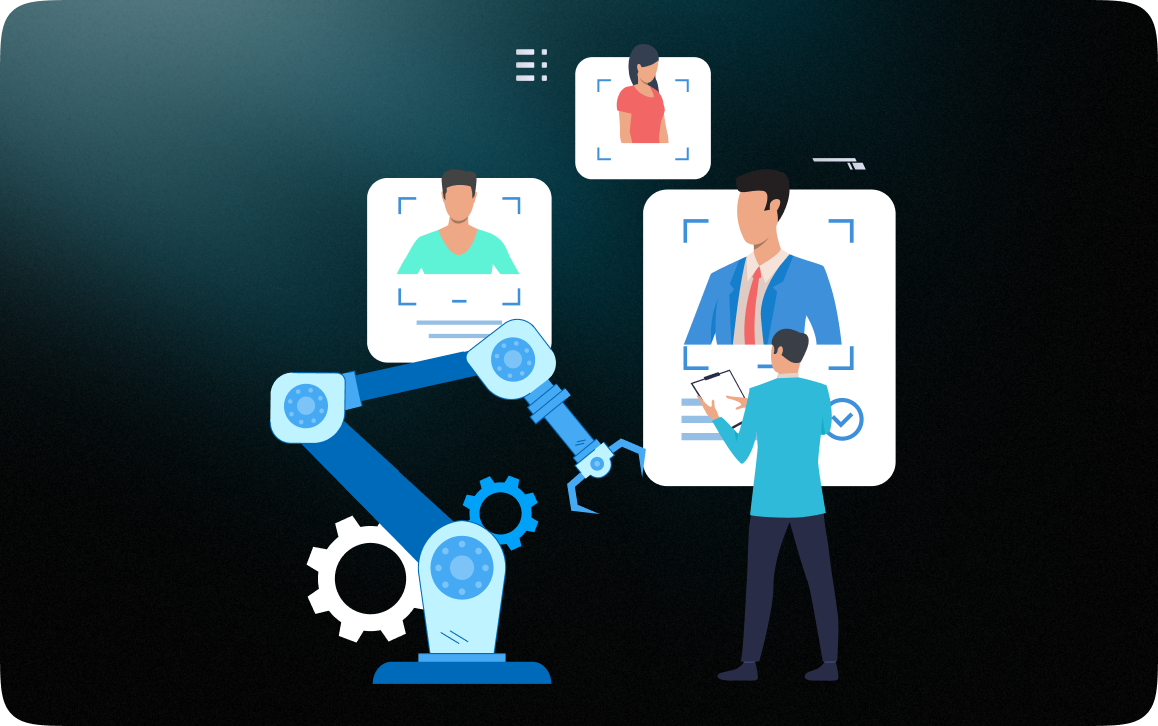


300 applications. 1 opening. 2 recruiters already swamped with 5 other roles to fill.
Someone has to spend the next three days reading through these applications, from the brilliant to the bizarre, trying to ensure consistency in quality as they go from application twelve to application two hundred and forty seven, all while fielding candidate emails, setting up interviews, and doing the hundred other things that make up a recruiter’s actual job.
This is the part of the process that drives people crazy - not the offers, not the interviews, not even the tough decisions. It’s the first round screening that takes up the largest chunk of time and delivers the least amount of value in the eyes of many recruiters.
Agentic screening is a different approach to first-round screening that replaces the work of an individual reviewer with an autonomous AI agent, and that makes a world of difference.
Agentic screening is the use of autonomous agents, AI programs capable of taking action without direct guidance - to review applications at the top of the hiring funnel, without active human input.
The key to the definition is ‘without active human input’. At its core, it is different from the kind of AI-assisted screening that most recruiters are already using in their hiring processes. These tools are great enablers, but they are only as good as the people using them, since they lack the capability to operate completely independently.
On the other hand, an agentic system is one where the work that would normally be done by a person reviewing resumes and deciding which applicants receive a second look is done by an AI recruiter instead. The AI agent operates on its own to complete specific tasks - scanning applications, finding the best fit candidates and making recommendations to the recruiter. They do not replace the recruiter’s input or override their decision, only making the work easier by taking over more of the process.
“Agentic screening” refers to this capability of operating independently and completing actions that would ordinarily require a person.

Most articles on this topic get very deep into how agentic screening differs from traditional methods, what it technically means for the tools. Here is what it means for the process from the recruiter’s and the candidate’s perspective, step by step.
An agentic screening tool operates on applications as they come in, rather than leaving them in a pool for a recruiter to screen when they have time.
A good agentic screening tool reads the application like a human reviewer and can extract information based on the context of the whole document. Rather than looking for keywords to decide whether a candidate meets certain criteria, an agentic tool can comprehend the application and make decisions based on the information conveyed. An application that includes three years of experience running a business before entering the job market will be understood as such, rather than being rejected because it does not specify the position they held.
Each candidate is scored based on how well they meet the requirements of the opening and ranked. The ranking is done using the same criteria a human recruiter would use to score the applications, but it is applied consistently, eliminating the possibility of unconscious bias affecting the results of the screening.
The top candidates are reviewed by the recruiter, but the screening tool takes over the next steps of the application process. It contacts the candidate, sets up screening interviews, and takes any other action that would ordinarily be done by a recruiter, up until the point of final approval.
When the recruiter returns to the application, rather than three hundred or more unsorted applications, they see a shortlist of the best candidates, along with notes from the screening tool explaining the rationale behind the selection.

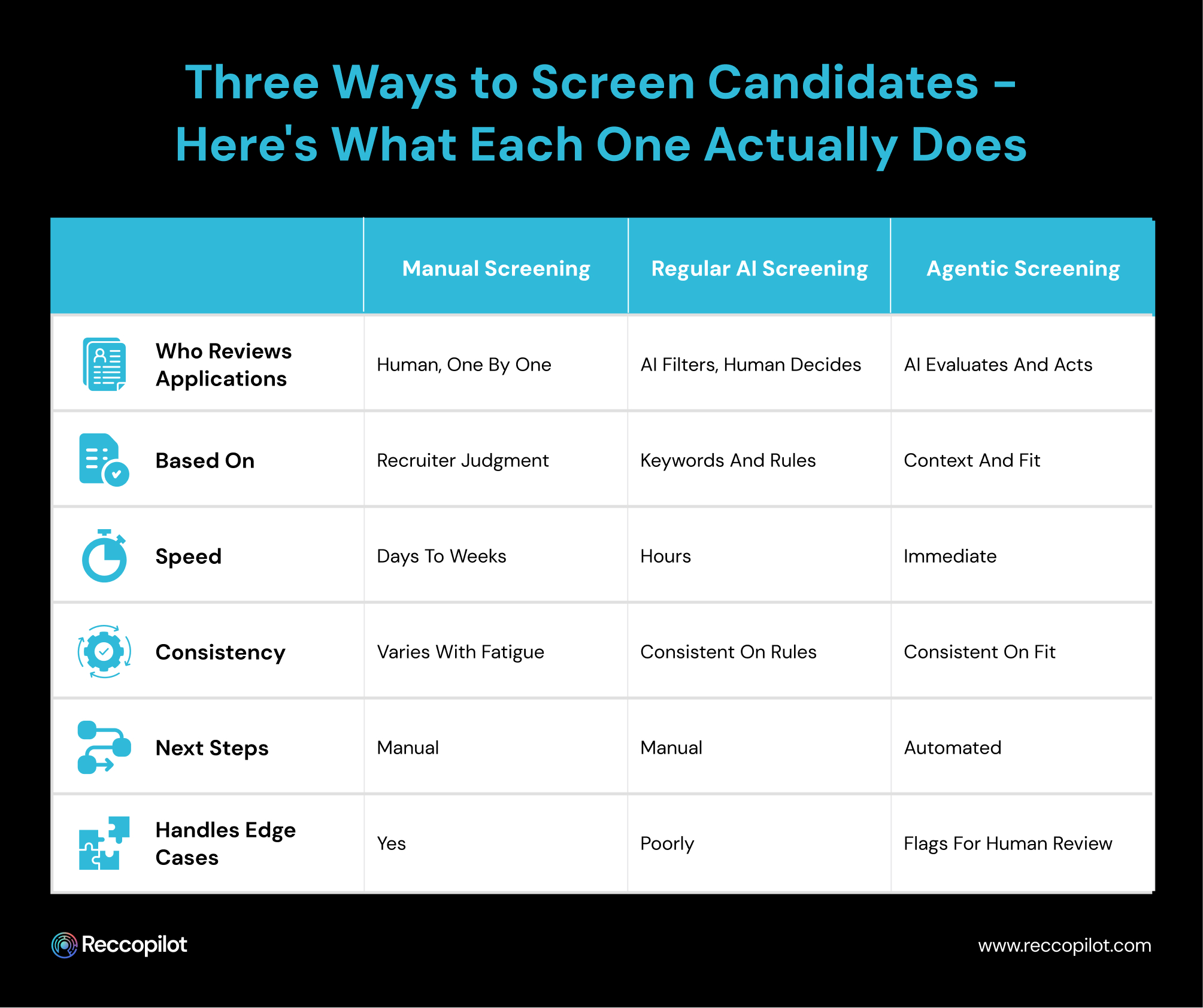
A common question that comes up in relation to this topic is how agentic screening is different from regular “AI screening”. To summarize the short answer presented at the beginning of this article: These AI tools are great time savers, but they only do specific, predefined tasks, leaving the judgments and decisions to actual people.
The regular AI-assisted screening tools are more of a time saver, since they cut out the bulk of obviously unqualified applicants so that the recruiter only needs to review the ones that have a realistic chance of fitting the requirements of the job opening. An agentic tool goes beyond that to manage the entire flow of the hiring process, rather than just speeding up one part of it.
For recruiters that rely on high volume hiring, the difference is significant, since the typical corporate job opening has around 250 applicants nowadays, compared to around 140 in 2021. The entire hiring process typically takes around 44 days from start to finish with AI-assisted screening, compared to 60 days without it. In a competitive job market, this makes a noticeable difference, since studies show that the average candidate only takes around 10 days to accept an offer once they start looking.
While most articles conclude on this note, there is one very important reason the reader should care about this information, what does it mean for candidates?
We have all been there, applying for a job, not hearing back, waiting for two weeks, and then getting an automated rejection email that serves absolutely no purpose other than to confirm we did not get the job.
That experience is so normal that, nowadays, candidates do not expect anything else - that the next step after they apply is a month long no response void, and then an automatic rejection.
Agentic screening makes a difference for candidates too, by providing shorter hiring cycles. Since an autonomous agent is continuously running and handling applications, as soon as a qualifying application comes in it can send an email to the candidate asking the screening questions, set up an interview, and do all of this faster than a human recruiter could, since it does not take breaks or days off.
The questions can be answered faster as well, since the agent can be embedded to answer frequently asked questions on the spot, rather than forwarding them to a recruiter and wasting the candidate’s time.
It makes the hiring process smoother for candidates, which is an important consideration for employer branding purposes. The way candidates behave after applying can have a lasting effect for recruiters, both good and bad.
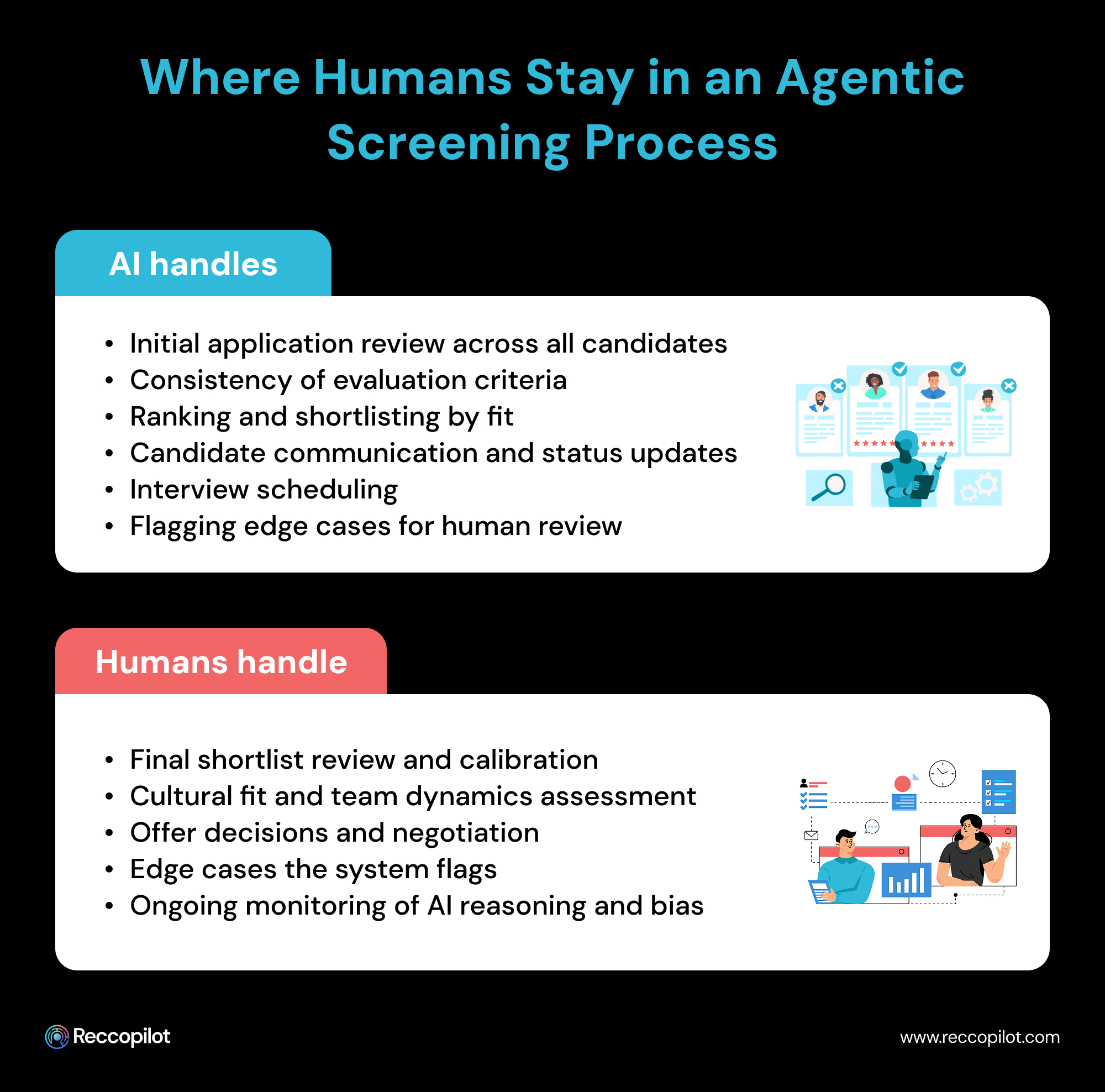
The volume of applications that agentic screening is best suited for is handled by the algorithm, but the actual candidate evaluation still done by people. This has a twofold advantage, it ensures that applications are screened objectively, and it makes better use of the time of the recruiters.
Recruiters can focus more heavily on the most important activities in the hiring process - talking to candidates, answering their questions, and having a conversation with them about what they are looking for in a job, rather than spending long hours screening hundreds of CVs. According to research data, AI-assisted recruitment drives reduce the time to fill by approximately 40%, with screening and outreach being the main advantages.
The best way to think about it is, if a person is reviewing applications and making decisions about who gets to move to the next step and who does not, that is not screening anymore. That is hiring, and the AI is used as an enabler rather than a replacement. In general, it is best to consider AI-driven recruitment as a tool that does the first conversation in some scenarios so that the human recruiter can have a better second conversation.
In some cases, the agentic tools replace some parts of conversations entirely, such as initial interview scheduling, because people tend to take long to reply, making the hiring process unnecessarily slow.
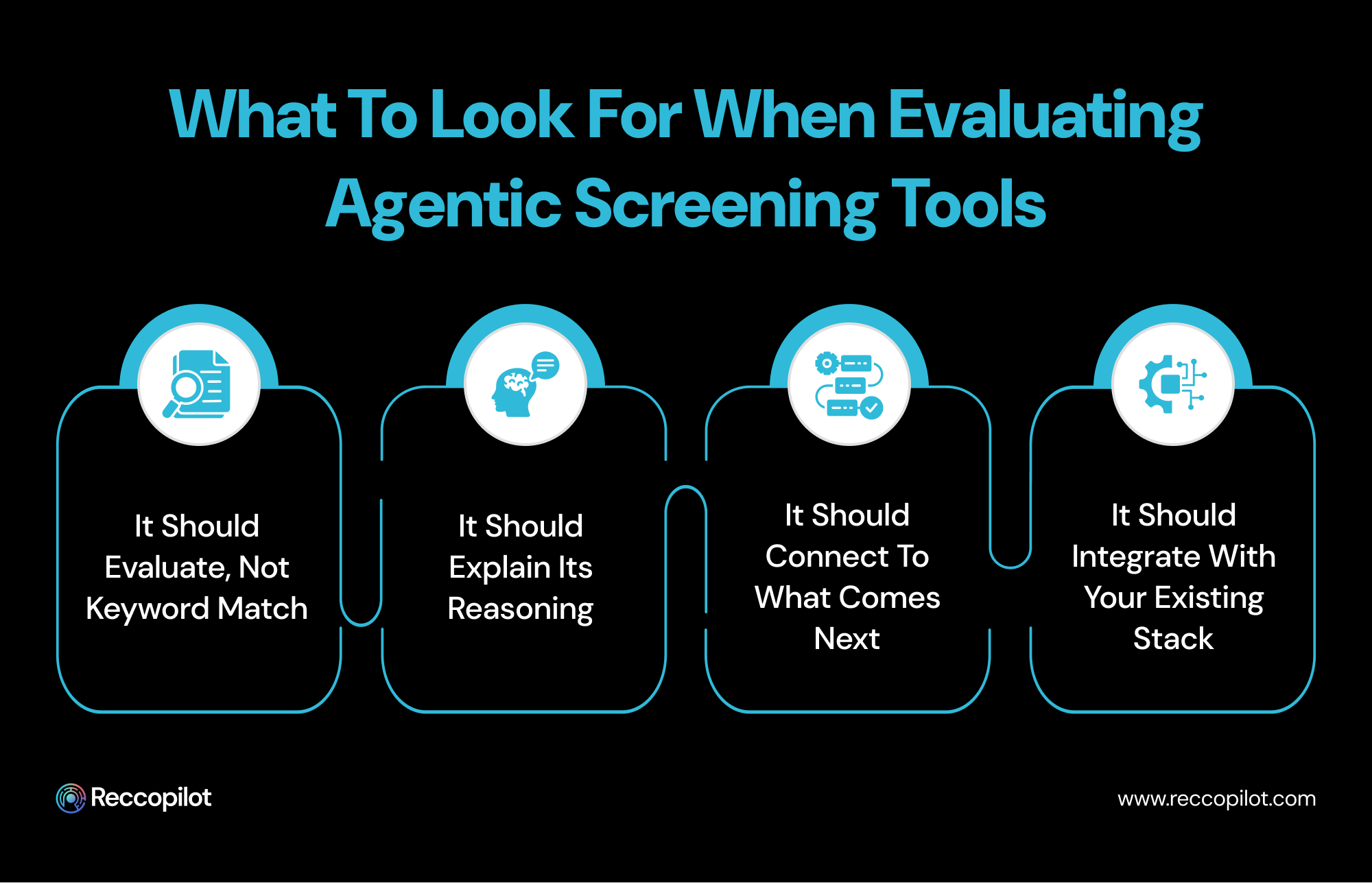
As was mentioned at the beginning of this article, not all tools that claim to offer “agentic screening” actually do. A few simple considerations will help determine which tools actually streamline the screening and hiring process.
Tools that analyze the content of the CV rather than looking for keywords are generally more useful and indicative of higher quality candidates, with fewer false positives and negatives.
A screening tool that produces a shortlist without explanation is more difficult to use and less transparent than one that provides reasons for each candidate’s score.
Screening tools that streamline the hiring process need to have the capability of connecting to the next step in the process, whether it is another screening tool or the candidate outreach and interview scheduling. This is the main difference between a true “agentic” tool and one that simply automates paperwork.
If the screening tool is intended as a standalone tool, that is generally less useful to the recruiter than one that can be embedded in their ATS or existing tools for staffing, scheduling and candidate outreach. The reason is that it is easier to adopt and easier to maintain.
Reccopilot’s AI recruiting agent is built on these principles - the ability to screen candidates based on their fit for the role rather than keyword presence, to build an easily understandable shortlist of candidates, and to operate as an independent agent that moves candidates along in the hiring process automatically, reducing the need for manual actions. The platform offers a free trial that allows recruiting teams to test it out on real requisitions to see how it impacts their hiring numbers directly.

Agentic screening is not a magic bullet for all of the problems in the hiring process, but it does address several issues at once, the volume of incoming applications, the time investment required for screening and making the initial offers, and the general annoyance factor of the process for both side.
It still requires people to make decisions about who gets hired, which might seem counterintuitive at first. But in reality, it is a huge advantage.
People will continue to make the most difficult decisions in the hiring process, while reserving the easier ones for the AI. The more time a recruiter spends on a difficult conversation, the more conversations they should be able to have overall.
This is how most people think about staffing conversations, in general having one difficult conversation where the answer is not obvious, followed by several easier ones where the outcome is clear. If there is a role that requires a very specialist skill set or experience, and there are three candidates that fit the requirements but only one is likely to accept the offer, this is the conversation the recruiter should have. An AI recruiting agent should highlight it or recommend it, but it cannot be a conversation the agent is supposed to have.
At the same time, if somebody has an edge background that does not obviously support the requirements but could potentially qualify nonetheless, these are the cases where an AI would typically recommend candidate outreach instead asking outright. People are good at getting answers to difficult questions - they might take longer, but they know how to navigate the situation. If nobody knows what the answer is, that can be an AI problem.
It comes back to the same question regarding bias - whether it is desirable and how it can be eliminated. In many practical cases, the answer is fairly simple. Agentic tools reduce inconsistencies in the hiring process resulting from the biases of individual recruiters, because a consistent algorithm is making decisions rather than several possibly inconsistent ones.
This is why bias cannot simply be removed from the hiring process, but it can be controlled. A new model that does not follow the same patterns will contain less bias by default, and there are various safeguards that can be put in place to test new models to ensure this is the case. New models need to be observed continuously and tested, rather than simply deployed and forgotten.

Agentic screening is an established practice across many fields, where it provides clear benefits to professionals. In recruitment, it serves a similar purpose, addressing the volume problem, reducing wasted time and providing an overall better candidate experience.
It is an important tool across the recruiting space and continues to evolve as an enabler across multiple hiring functions. Understanding its role and being aware of the limitations it has is the most important consideration for recruiters looking to integrate it into their hiring practices.
Three hundred applications do not need to consume three full days of a recruiter’s time, and there is existing technology to change that.




