


Reducing Time to Hire with AI in Recruitment: What Actually Works
Read Time
7 Minutes
Updated On
April 21, 2026
.jpeg)


Do you remember that one strong candidate who went quite mid process, then You already know what Slow hiring is costing you. They did not ghost you; they got an offer somewhere else faster and quicker. In today's recruitment process, the time between a candidate applying and accepting an offer isn't just an HR metric; it's the difference between How you are building the team you need and starting the whole search over again.
Right now, reducing time to hire has become one of the most important and widely discussed challenges in talent acquisition and for good reasons of course. Companies that are moving faster are consistently winning candidates that slower moving competitors lose. The good news is that AI in recruitment has made it genuinely achievable to cut hiring timelines without cutting corners on quality and saving tons of time.
In this blog we will talk about why time to hire matters today and what is actually slowing your hiring process and how AI in the recruitment process can help your team across different industries hire better and faster.
Time to hire is the number of days between when a candidate enters your pipeline and when they accept your offer. It is different from time to fill (which usually starts from the day when the role is opened), and it is arguably more useful because it tells you how efficiently your actual recruitment processes runs and how quickly you hire.
We know a lot of hiring teams that track their time to hire but very far fewer actively work to improve this number. That is a very huge problem because the data on what slow hiring costs is hard to ignore. And to be honest, we don't know how some companies are ignoring it even after knowing that.
But on the other hand, organizations that have worked out how to reduce time to hire consistently; they see positive and stronger outcomes, not just faster hiring, but better retention and higher revenue growth as well. When the process works well, everything downstream works better as well.
So now the question is how do most companies measure time to hire and improve it right? The measurement part is pretty simple, most ATS platforms track it automatically. The improvement part is where most teams get stuck because the Bottlenecks are usually structured rather than individual, and that is exactly where AI in recruiting comes in hand.
Before getting straight to the solutions, it is very important to be honest about where time gets lost. In most organizations running mass recruitment, the delays aren't happening at the decision-making stage; they're happening in the administrative layers around it.
One recruiter has to read every application; another has to find a time that works for the candidate, the recruiter, and the hiring manager. Then someone has to send the confirmation, then the reminder, then follow upon the document that never actually came back. All of this takes time, and most of it doesn't actually require human judgment at all. It just requires a human to do it, which is mainly the problem.
Add to that the reality that candidates today are not even waiting around. They are applying to 15-20 companies simultaneously. Every day of silence is a day they are getting warmer on someone else's offer. The competitive disadvantage of a slow process doubles or triples quickly. Especially in high volume hiring scenarios where the volume of applications makes manual workflows genuinely unmanageable and tough.
The most effective strategies to reduce time to hire all point in the same direction: remove the manual work from the stages where it doesn't belong, so that human attention can go to the stages where it does.
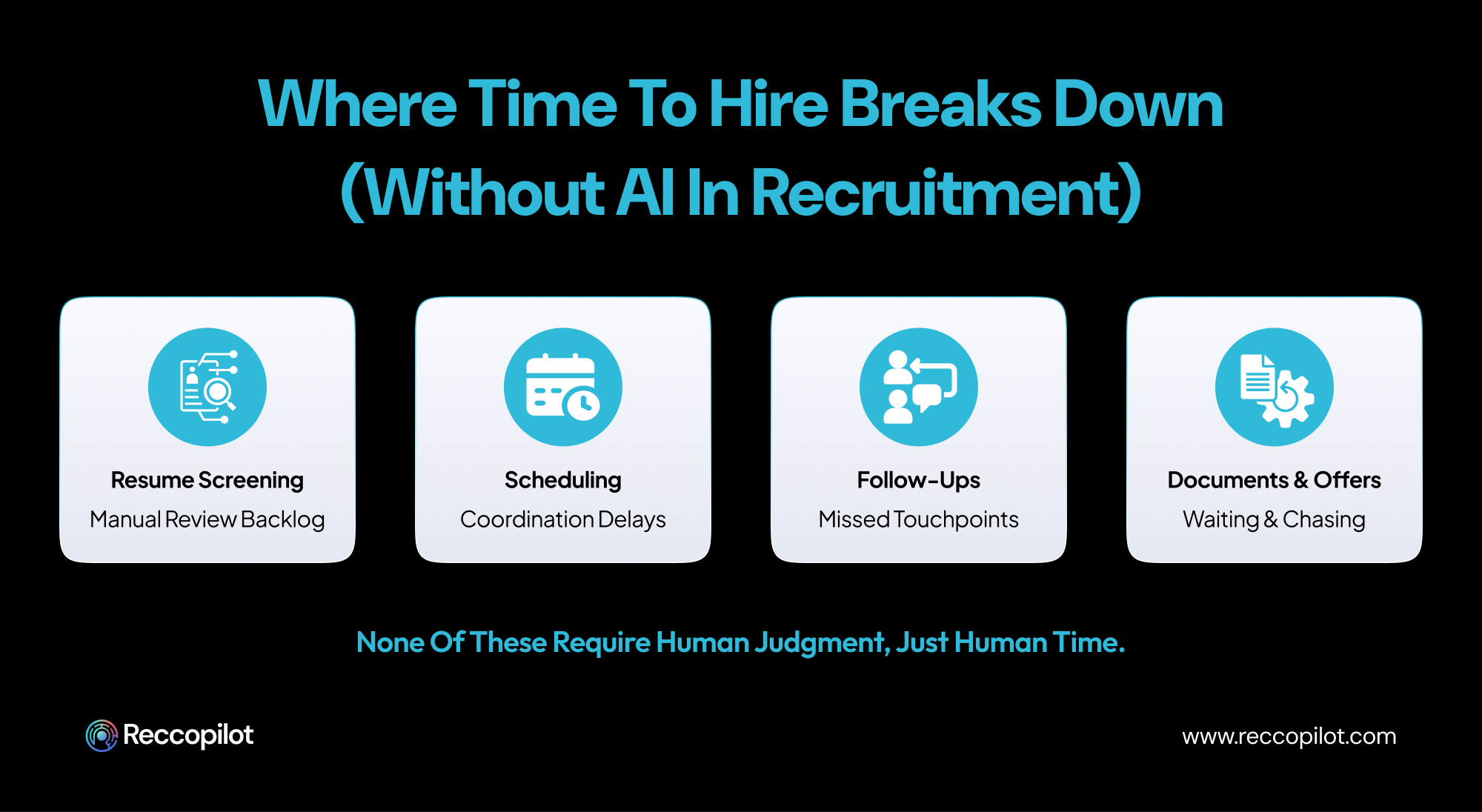
AI in recruiting automation was never and is never about replacing recruiters. It is mainly about removing the parts of the job that were never a good use of their time in the 1st place. Modern AI recruiting Tools use machine learning, natural language processing and predictive analytics to handle the repetitive and time sensitive work that currently creates problem in most hiring processes.
Here's where the real impact shows up.
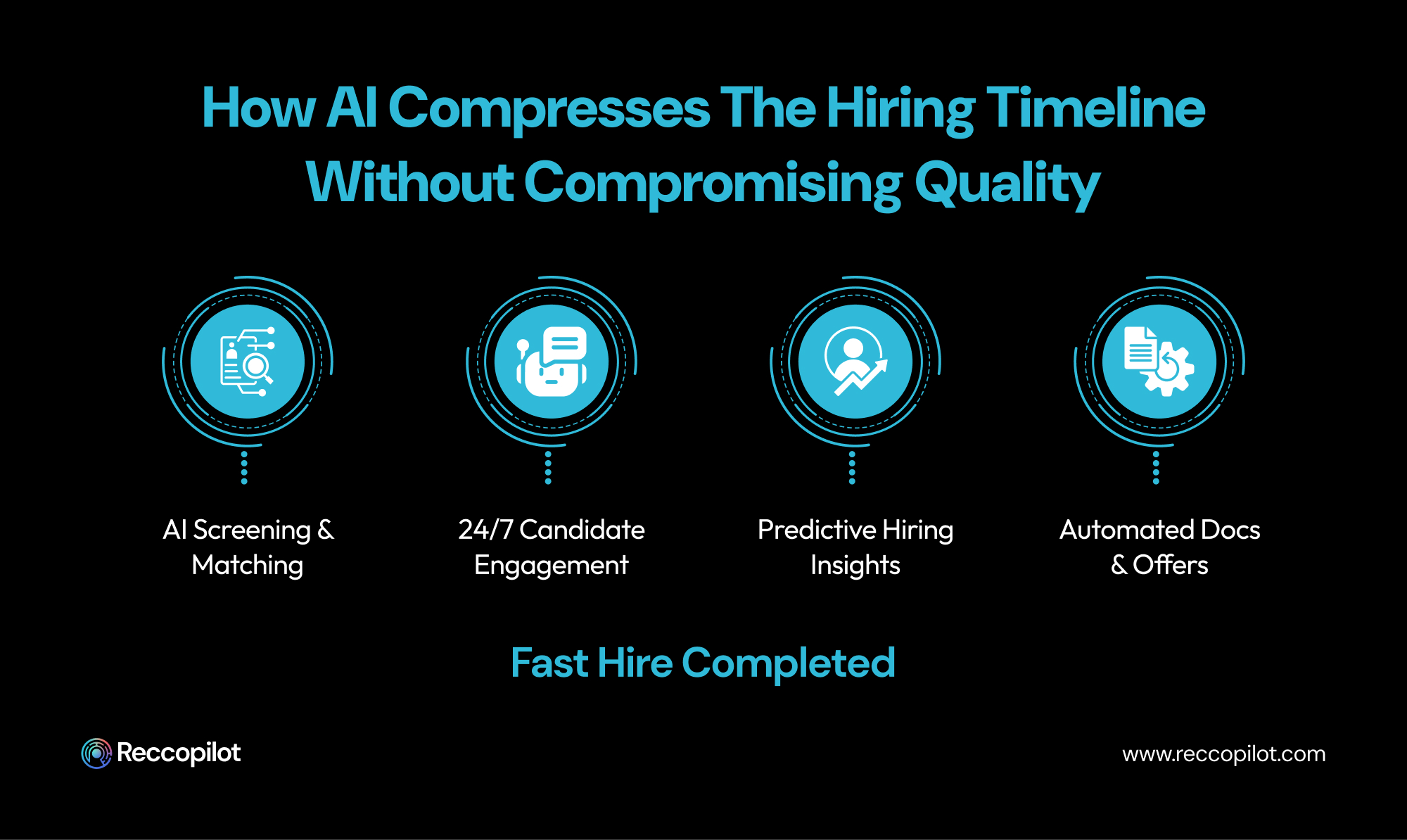
The old way of resume screening averages 23 hours per hour. That's not because recruiters are slow; it's because manually reading through hundreds of applications is very time-consuming work and doing it well requires consistency that's hard to maintain at volume.
AI in HR recruitment handles this differently. Rather than keyword-matching (which misses good candidates and passes through bad ones), modern screening tools use semantic analysis to evaluate candidates based on actual capabilities and role fit. A candidate who describes a skill differently than your job post uses it still gets surfaced. One who technically matches the keywords but lacks the relevant experience gets flagged appropriately.
One of the major issues of dropping off in recruitment is candidate engagement. A candidate applies hears nothing for five days and starts to wonder whether the company is actually interested. By the time an automated confirmation finally goes out, they have already moved on, mentally or literally.
AI agents in recruitment fix this problem by ensuring no touchpoint gets missed. When a candidate applies to a job, they hear back within seconds. When they advance to the next stage, they get an update before an interview; they receive a reminder. All of this happens automatically without a human recruiter manually crafting a single message every time.
AI chatbots increase this further by handling inbound candidate questions at any hour of the day. What does the interview process look like? What are the next steps? What does the role involve day-to-day? Candidates get answers immediately instead of waiting a day for a recruiter to get to their e-mail. Organizations using AI chatbots in their recruitment processes consistently report higher candidate satisfaction and lower drop off rates throughout their process.
Most hiring teams are ready to respond or react. A role opens; a search begins, and the whole teams scrambles to fill it. AI in HR recruitment makes it possible to shift that to change that pattern by using previous data to forecast hiring needs before they become urgent, so that by the time a role officially opens, there's already a warm pipeline to draw from.
Beyond forecasting, predictive tools can assess the likelihood of candidate success based on performance data from previous hires in similar roles, flag which candidates are most likely to accept offers and stay long-term, and recommend salary ranges that maximize acceptance without going over budget. These capabilities directly address one of the most expensive parts of a slow hiring process: making a great hire, only to have them leave within a year.
According to IBM research, 85% of CEOs expect positive ROI from AI efficiency investments by 2027, and 61% are already actively adopting or scaling AI agents across their businesses.
The last stage hiring delays are most often caused by the mundane things: a background check form that was never filled out, a certification document sitting in a candidate's inbox waiting to be uploaded, an offer letter that needs 3 signatures from people who are in three different time zones.
AI in the recruitment process handles all of this automatically. Document requests go out at the right stage, reminders follow if they haven't been submitted, everything gets stored and organized in one place, and offer letters are generated and delivered without anyone having to manually draft them. Organizations using these tools report up to 40% fewer onboarding delays and significantly faster offer acceptance timelines, while staying compliant and audit-ready throughout.
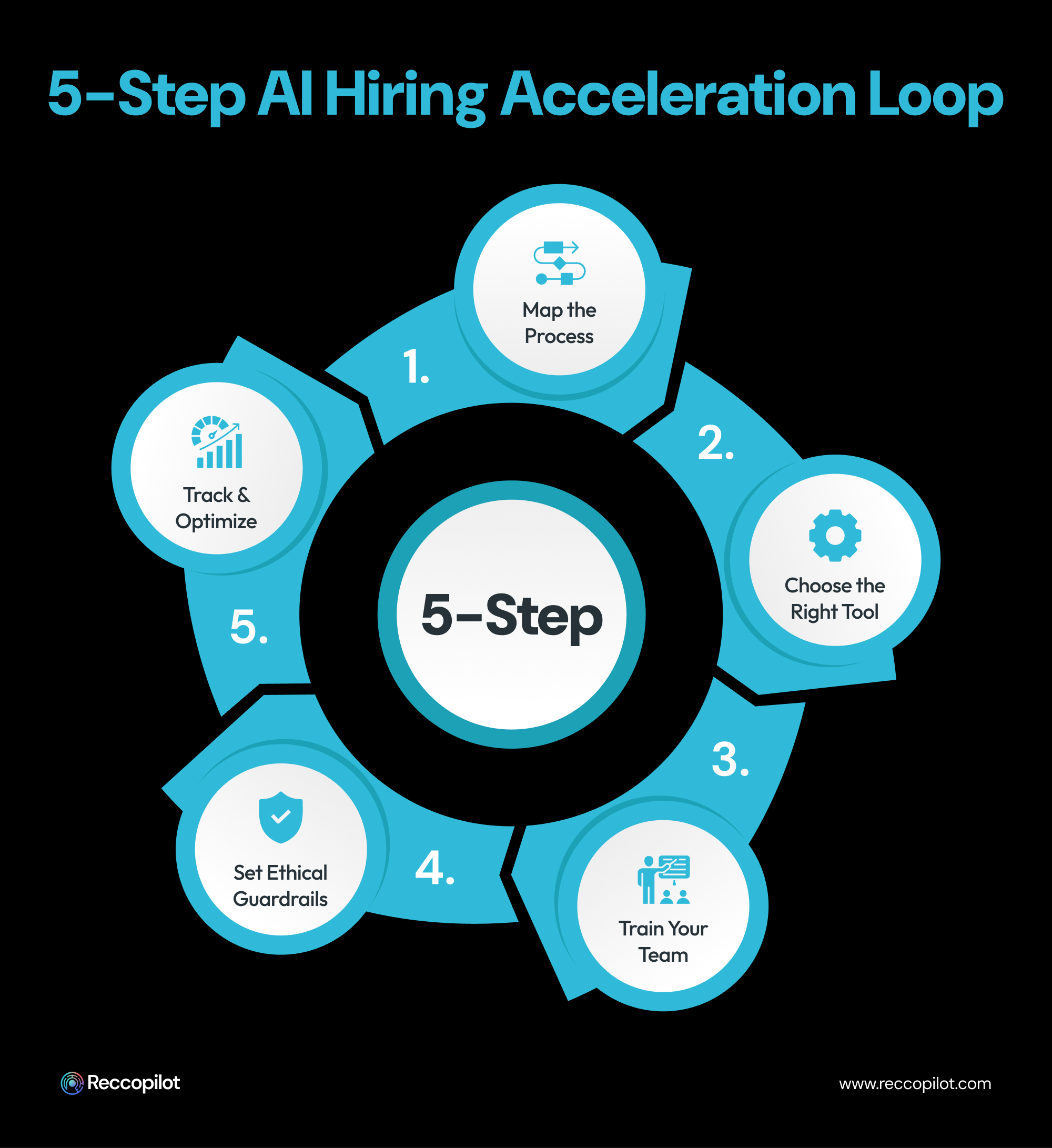
Knowing that AI in recruiting works and getting it working in your organization are two different things. The implementation gap is where most teams stall, not because the technology is too complex, but because the rollout isn't approached strategically. Here's a grounded, practical approach that works for teams of all sizes.
Before you go ahead and choose any tool, you actually need to spend time genuinely understanding your existing workflow. Where are your candidates dropping off? Which stages consistently take longer than they should? Where is your recruiter time going and how much of it is genuinely judgment driven versus administrative. This audit does not need to be elaborated. Just pull your last three months of hiring data, map the average time at each stage and look for the problems. A role that took you 45 days when your average is 28 days usually has a problem or an issue behind it.
Interview scheduling is frequently the single biggest problem, it's worth checking whether that's true for your team. This foundational step is what separates AI implementations that deliver measurable improvement from those that automate a broken process and wonder why nothing changed.
Once you know where your time is going in the whole recruitment process, look for AI recruiting tools that directly address those hold-ups. If you find that there is more than one specific problem in your recruitment process, you need to look for a tool which offers more than just one feature. For example, if screening is something that limits you and the candidate drop-off is another issue that you face, then you need to look for tools which offer both or more features.
If you're looking for a practical starting point, Reccopilot brings AI recruiting automation, screening, scheduling, candidate communication, document management, and pipeline tracking, into one place, it is built for teams who want to move faster without adding any more complexity to their recruitment process. There's a free trial available so you can see how it performs with your actual hiring process before committing to anything.

The technology side of AI in recruiting is typically the easier half. The human side, getting your team to trust it, use it consistently, and know when to override it, is where most implementations quietly fail. Effective training goes beyond showing people how to click through a new interface. It covers how to interpret AI-generated candidate scores, how to maintain the human connection in a more automated process, where recruiter judgment is still essential, and how to spot when automation is producing unexpected results.
Change management matters here too. Recruiters who've been manually managing every candidate touchpoint for years may feel displaced by automation rather than supported by it. The framing matters: this technology is taking the administrative load off their plate so they can focus on the relationship-driven work that requires them.
AI in HR recruitment comes with real responsibilities around fairness and transparency. AI tools trained on historical hiring data can inadvertently encode the biases present in that data, which means if your historical hires skewed toward certain demographic profiles, your AI may perpetuate that pattern without anyone noticing.
Building in ethical guardrails from the start is both the right thing to do and a practical competitive advantage. This means using diverse training data sets, scheduling regular bias audits, maintaining transparency in how candidates are evaluated and progressed, and having clear human review processes for AI-generated decisions at critical stages.
AI implementation isn't a one-time project it's an ongoing process of measurement and improvement. Set up clear baseline metrics before you start so you can actually quantify the improvement: time to hire by role and department, candidate satisfaction scores, stage-by-stage drop-off rates, quality of hire at 30, 60, and 90 days, and cost per hire. Then revisit these monthly, not quarterly. Monthly review cycles let you catch problems early, an automated message with a low response rate, a screening filter that's cutting good candidates, a scheduling workflow that's creating confusion rather than clarity.
AI in recruitment is not taking over recruiters’ jobs. It is coming for the parts of their jobs that were never a good use of their skills. The confirmation emails, the scheduling chains, the document chasing when tasks like that run automatically in the background, recruiters get to spend their time on the things that determine whether a hire works: the conversation, the judgment call, the relationship.
Do we think that technology can help decrease the time to hire? Yes, significantly and measurably. But the organizations that will get the most out of it are not just plugging in a tool and watching their metrics improve. They are being intentional about where they apply it and how they train their teams to use it and how they keep refining it over time.




