


What Is E-Recruitment? A Simple Guide for Modern Hiring
Read Time
7 minutes
Updated On
July 29, 2026
.jpeg)



Remember when job ads were in the paper?
You had to wait a week after placing the ad in the paper to get ten applications, which were all hand delivered to you by post. Manually typing everything into an excel sheet on your own desktop. Scheduling interviews required days of phone tag, and you could miss a potentially good candidate because you didn't return their call in time.
Nowadays, you post a job ad online at nine in the morning and have fifty applications by lunch. Everything is digital and instant. Candidates are on their phones during their commute, and hiring managers are sorting through resumes for job seekers in three different cities who have yet to meet in person.
That's e recruitment for you. And if you've ever posted a job ad on LinkedIn or had a candidate send you their resume via email, chances are you've already participated in e recruitment, even if you didn't think about it.
Most people who use e recruitment tools are likely not thinking through how these tools actually work or how they could be making the most of the technology at their disposal.
So let's talk about that. E recruitment explained: what it is, how it works, what it does best, what it does worst, and how to get the most out of it. How is it different from traditional recruitment? And what makes some companies more successful at it than others?
E recruitment, also known as electronic recruitment or e recruiting, is the use of technology and the internet to find and hire new employees. That's the short answer. Everything else is more detail than most people need to know.
Instead of newspaper ads, you post the job online. Instead of getting piles of paper resumes in the mail, you get applications through an online platform. Instead of filing cabinets full of documents, you have everything digitized and searchable. Instead of phone tag when scheduling interviews, you send out a link for candidates to sign up for slots in your calendar. Etc.
At a very basic level, e recruitment consists of:
That's a very simplistic view of it. But a good starting point nonetheless.
This can be done on online job boards, on individual company career pages, or on both at once. Instead of waiting days or even weeks for a newspaper ad to run, you can post the ad online and it has legs immediately. The job posting can reach thousands of people by the end of the day it's posted.
Candidates will find your ad, and rather than having to print out a resume and mail it or drop it off in person, they can apply digitally. There's no wait, and no stack of paper on your manager's desk. Their application is waiting for you in your e recruitment software.
Once you've got these digital applications in, they can be organized automatically. No more filing cabinets or stacks of paper. Everything is digital and searchable. No more searching through dozens of resumes with no way to tell which ones you've looked at already if you need to go back.
This step is why most people who are hiring say they prefer e recruitment. Most e recruitment softwares can automatically sort through applications and narrow them down based on keywords or other criteria. What used to be a three day long process for a single recruiter can be finished in a matter of hours by an algorithm.
Sending out emails, tests, interviews, etc. Everything can be done digitally and usually faster than any traditional method. Candidates don't have to go through the hassle of setting up a bunch of in-person meetings and you don't have to worry about the candidates' availability nearly as much.
Your hiring team can review candidate profiles, leave notes for each other, rate candidates, and more, all digitally, rather than having to be in the same place and time.
Candidates can be sent offer letters via email, complete onboarding digitally, and much more.
.jpg)
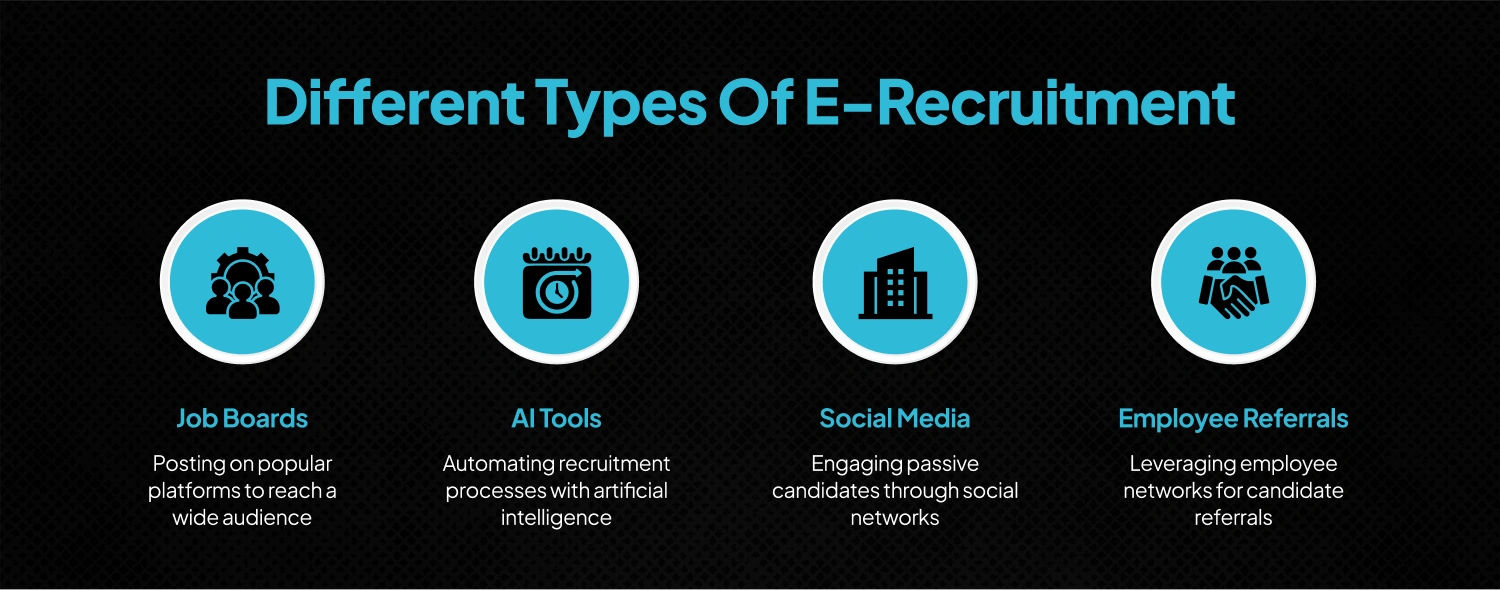
When most people think of e recruitment, they might not realize it encompasses a lot of different things. There are many different types and most companies combine multiple together.
Job boards and company career pages: As mentioned briefly above, these are places you can post job ads online, and they tend to be the starting point for most e recruitment processes. Some job boards allow you to post ads for free while others require payment.
Using LinkedIn, Twitter, or even Instagram to find and attract candidates. Particularly useful for reaching passive candidates - people who aren't actively job hunting but might be open to the right opportunity if it lands in front of them.
E recruitment software and applicant tracking systems: These are the systems used for managing the entire process, from posting a job ad to narrowing down applications, scheduling interviews, communicating, collaborating, and more. They tend to be the most valuable part of an e recruitment strategy since they allow you to manage the most aspects.
AI driven recruitment tools: These are the newest tools on the market, and most of them tend to focus on automating specific, repetitive tasks involved in traditional recruitment, such as sourcing, screening, and ranking candidates. Reccopilot fits into this category, since its main purpose is to let companies automate the most time consuming and unproductive aspects of traditional recruitment.

Employee referral platforms: As the name suggests, these are platforms used for managing employee referral programs. Having a digital system to manage these kinds of programs is important not only because it makes things more organized, but because it encourages employees to take advantage of the program. Referred candidates tend to stick around for much longer.
The majority of companies tend to use several of the types listed above, and most use combinations of them. Some post on social media, use an applicant tracking system, use AI powered tools to narrow down applications, and manage employee referrals through the same digital system. Whatever combination works, as long as it gets results.
The advantages seem endless, but here are the most important ones:
As mentioned briefly above, most e recruitment processes tend to be much faster than traditional options. Job ads can be posted and edited much more quickly and can appear instantly, rather than having to wait for a newspaper to print. The same goes for applications: they can be made and sent digitally in a matter of minutes rather than waiting for someone to mail them or bring them in person.
The most obvious advantage is the ability to narrow down candidates much more quickly as well. What used to be a multi day, multi person process can be done by a computer, usually in much less time. This kind of speed is incredibly important, especially when dealing with candidates that are considering multiple job offers. Companies that can't respond quickly enough will lose out on potentially qualified candidates just because they weren't efficient enough. That's a disadvantage that isn't nearly as prevalent with e recruitment.
Traditional recruitment methods usually revolved around newspapers and word of mouth. That limited the reach of these methods severely. A newspaper ad only had legs for as long as it was physically in print, and only the people who saw it could apply for the job.
A job ad posted online, on the other hand, can remain online for as long as you want and can be found by people all over the world, depending on what kind of job it is. It truly is a much larger reach compared to just relying on newspapers.
Printing newspaper ads used to be one of the most popular ways of advertising job openings, but it could also be very expensive. Online job boards usually allow you to post ads for free or for very cheap. There's definitely a noticeable difference when it comes to budgets.
Anyone who has dealt with traditional recruitment has had to face the headache of organizing things. Job applications used to be handwritten or printed out, which meant you had to keep them somewhere safe. Managing applications and resumes used to be an absolute nightmare, especially with hundreds or even thousands of them to deal with.
All of that can be avoided with E-recruitment; everything is much more organized, searchable, and can be managed much more easily.
Candidates applying for jobs can send in their applications from their phones or whatever device they're using. Everything can also be managed much more efficiently, which means candidates don't have to deal with the headache of trying to contact you if they have any questions. Candidates can receive quicker responses and clearer communication compared to traditional methods, helping them have a much better experience overall.
E recruitment also has the advantage of providing useful metrics that traditional recruitment usually can't provide.
You can track which job boards or platforms are providing you with the most candidates. You can see how long it takes to move candidates from one step to the next. You can see which step is the most difficult or time consuming. All of these can give you insight into what works and what doesn't in your recruitment process.
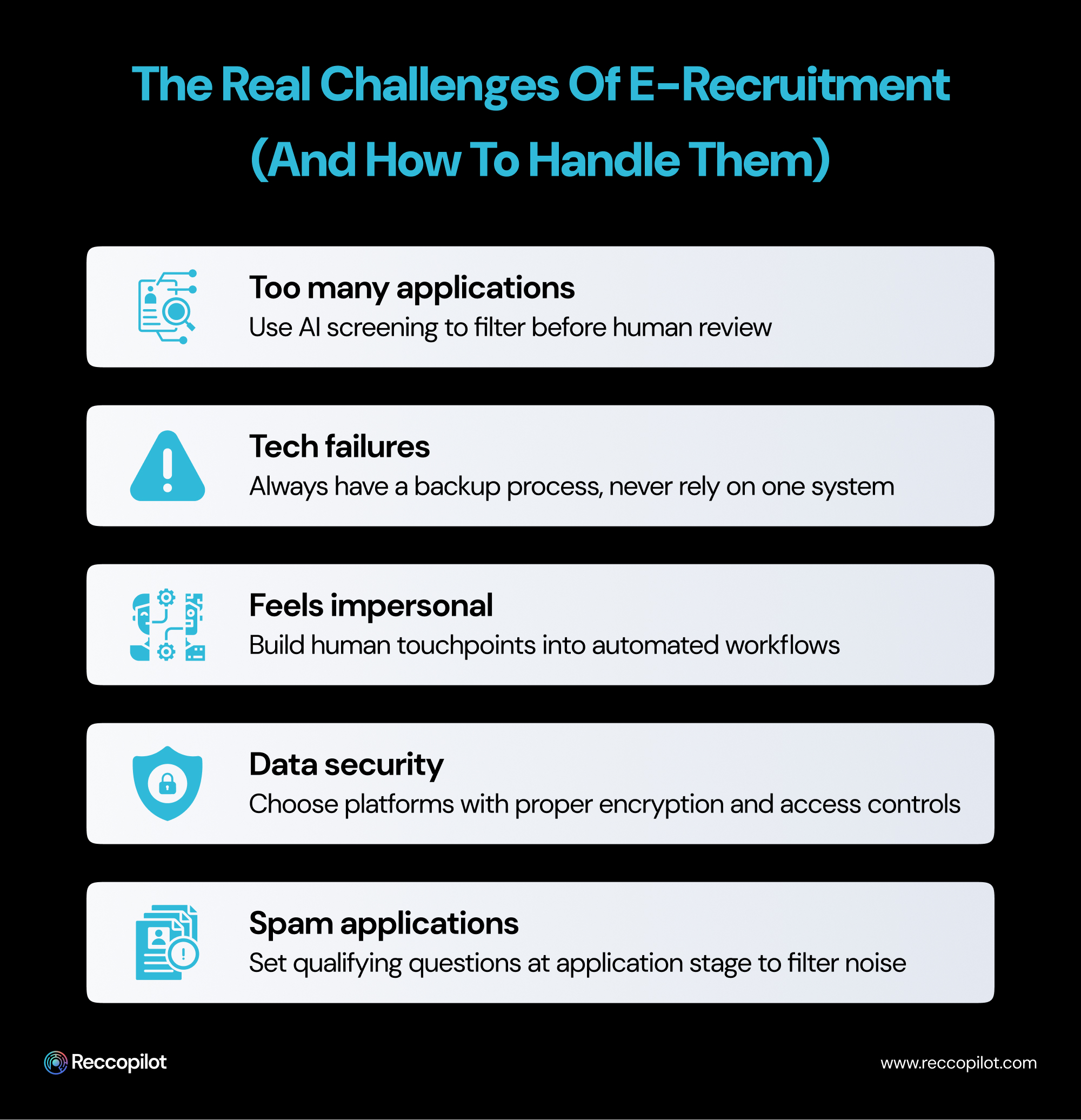
E recruitment systems aren't perfect, and it's important to understand both the good and the bad. Here are some of the potential disadvantages of e recruitment according to experts.
Having a job ad online means anyone can apply, which means you can get thousands of applications for a single job opening. While volume isn't necessarily bad, it can make it much harder to narrow down who you want. For example, if you get three hundred applications for a job opening and only twenty of them are qualified, that's a lot to go through.
Systems and websites can crash at times, leaving people unable to post job ads, apply for jobs, or do any number of other recruitment related tasks. Tech issues can definitely be a problem, especially when it comes down to having to cancel things because of them. Traditional recruitment methods like paper resumes simply don't have that problem.
Automated emails and applications may not always be effective, especially when it comes to candidates. Candidates can become turned off by the cold and emotionless language often associated with automated communication.
Having personal information on file digitally is important, which means it's crucial to make sure everything is secure. E recruitment tools and systems usually provide that security, but it's important to keep in mind that failing to do so can cause issues.
Traditional recruitment used to take place at a much slower pace. Job ads would have to be written out and placed in a newspaper, which took time and effort. Then you would have to wait for the ad to appear and for people to start applying, which could take days. Receiving applications used to be slow as well, with people sending in written applications by mail or in person.
Managing and organizing resumes and applications was a huge pain as well. This was all done manually and had to be managed individually for each candidate, which simply took too much time and resources.
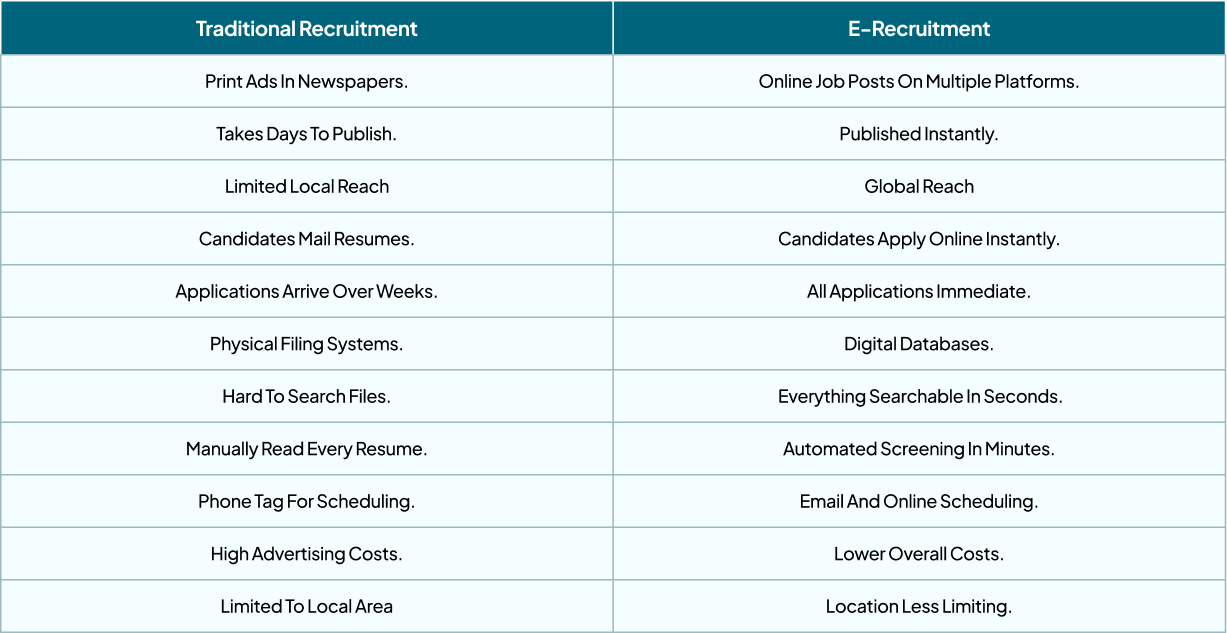
Compare all of that to e recruitment and you can see why the two are so different. Getting job ads online can happen instantly and can remain online indefinitely or until you remove it. Managing applications and resumes can be done much more seamlessly and quickly because everything is digital and can be done in bulk. All of these advantages allow e recruitment to operate at a much faster pace than traditional recruitment ever could.
Now that you know what e recruitment is and how it works, let's get into how to actually use it. Most people have probably unknowingly used e recruitment already, since most things you do online fall under this category.
The most basic things to do when it comes to e recruitment are to post job ads online and manage them with an e recruitment software. From there, there are a number of other things you can do to improve your e recruitment strategy. It's best to get comfortable with one thing before trying to learn another.
Once you're using an ATS to sort through job applications, for instance, it'll make much more sense to start using other recruitment technologies. Reccopilot offers a 14 day free trial to help you understand how the AI driven recruitment system can be useful to you specifically.

Companies that are doing the best in terms of recruitment are usually making the most of the tools at their disposal. The best way to make the most of recruitment technology is to understand how it works. That's where this guide comes in.




