


Recruitment Company Business Plan: How to Build, Grow and Scale Your Agency
Read Time
10 minutes
Updated On
August 6, 2026
.jpeg)



Most people who begin their recruitment business do not do it with a plan. They do it with a client. With a candidate. With a conversation that led to a placement that led to the understanding that they could probably do this on their own. The business comes first and the plan follows, somewhere between the third client and the first hire.
That works until it doesn’t, which is usually somewhere around when things start to get interesting.
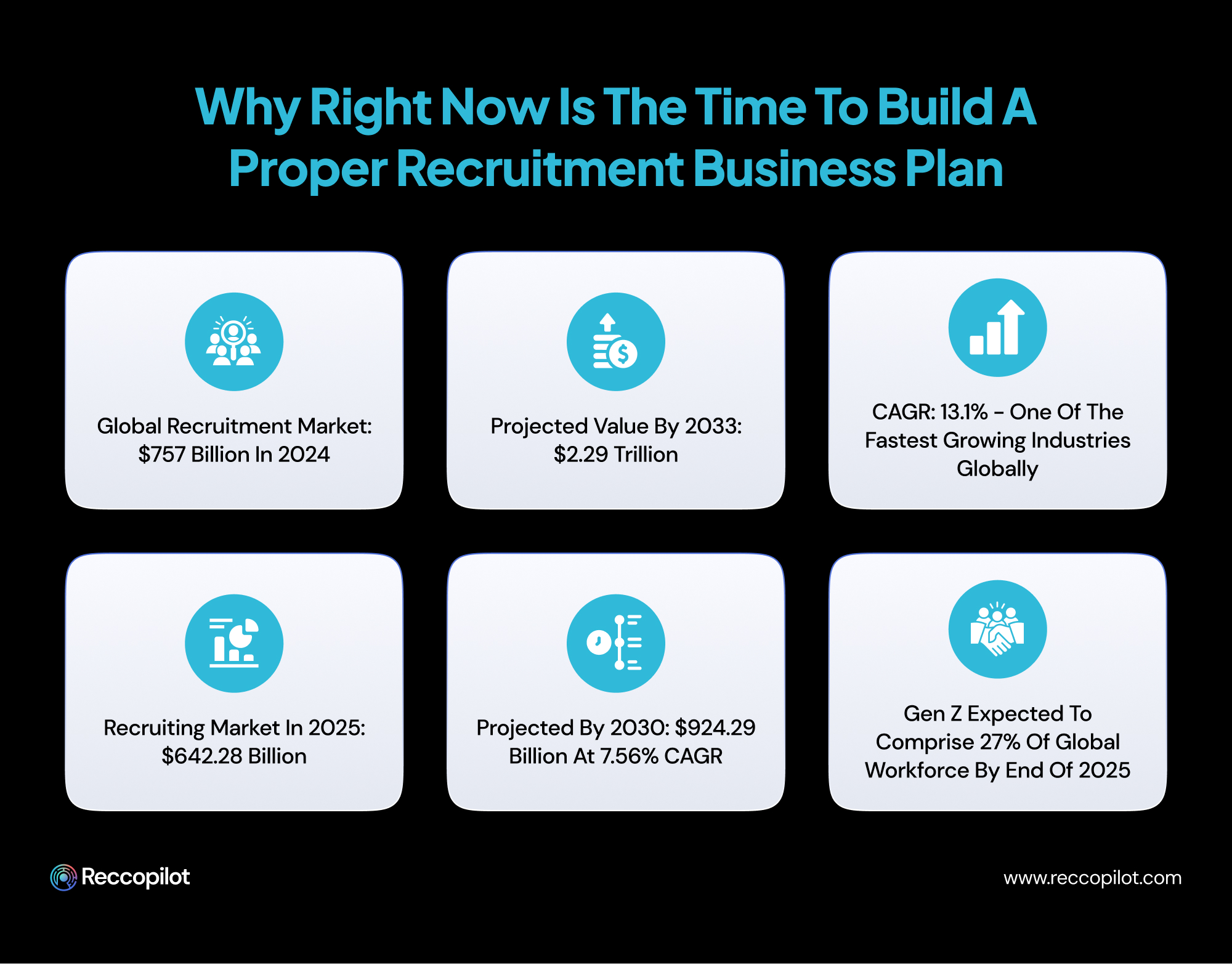
The global recruitment market is set to be worth approximately $757 billion in 2024 and is projected to reach $2.29 trillion by 2033, growing at a CAGR of 13.1%. That makes recruitment one of the fastest-growing industries in the world right now. The opportunity is undeniably there. But opportunity without a plan is just noise, and the agencies that are set to benefit the most from this growth are the ones that recognize that fact and act on it
Whether you are looking to build a business plan for a recruitment company from scratch or you need to update an old business plan for a recruitment agency, this guide covers everything you need to know to do it right. What to build, what to update, and what to stop doing.
A recruitment business definition is simple: connecting the right people with the right opportunities and profiting from them, but a business plan for a recruitment agency that wants to last is much more involved than most people who begin in the industry realize
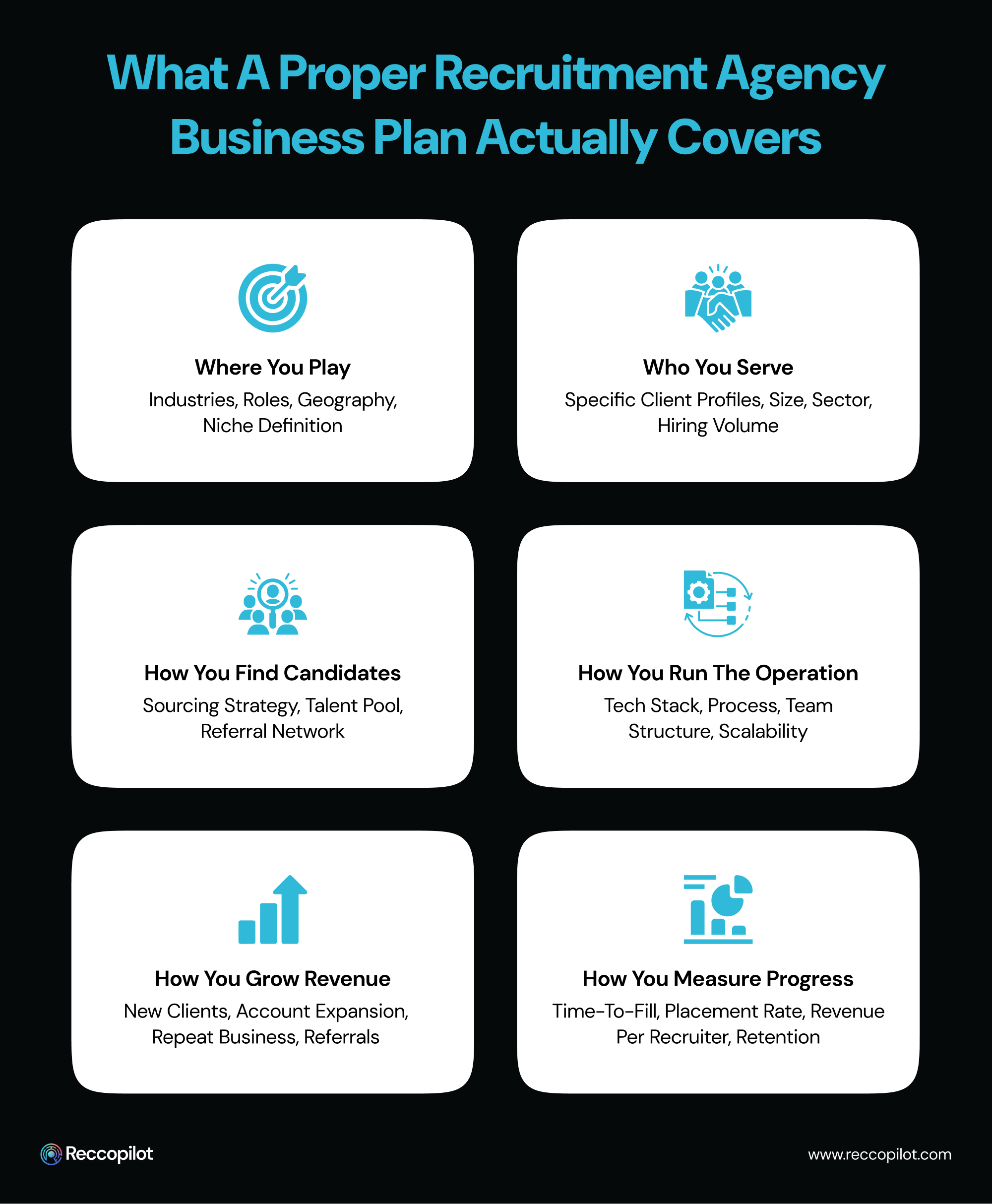
A proper recruitment agency business plan covers 6 things that actually matter:
A recruitment company business plan that covers these six areas in sufficient detail is the difference between managing on the fly and having an actual strategy, and the difference between succeeding and simply surviving as the competition begins to take shape.
Recruitment business development is something most agencies do on an ad-hoc basis. You take a referral, you follow it up on. You get asked if you do something you don’t, you say yes and learn on the go. You get cold calls, you answer them. It is all fine, but it is not a recruitment business development strategy. A business development strategy for a recruitment agency is something much more deliberate, with defined clients and prospects, a systematic approach to outreach, and a focus on building the reputation and presence required to get in front of the right people and get them to choose you over the competition
A recruitment business development strategy is what will let you understand which clients to target before they come to you and how to get in front of them before your competitors can. It is also about building the kind of presence that will generate inbound sales leads on its own, as well as maximizing conversion rates at every stage of the sales process so that you are not wasting time and effort on people who will never choose you, no matter how much you ask
The global recruitment market is set to generate $642.28 billion in 2025 and is projected to reach2030 (expanding at a 7.56% CAGR), with a large portion of that value predicted to go to the agencies that have a proper recruitment business development strategy in place
Specialization is one of the most important aspects of a recruitment business plan, as it is usually much easier to build a profitable business around a particular niche than it is to compete as a generalist. You may be able to generate more revenues by serving everyone, but you will also have to compete with everyone, and the market for general recruitment agencies is much more competitive than the one for specialists. Choose one or two niches to focus on and begin building your experience and expertise there.
Long-term relationships with clients are much more profitable than one-time placements, and they usually require much less effort to maintain than they do to acquire. A proper CRM, along with regular outreach and relationship cultivation, is the difference between a steady stream of repeat clients and a few one-time hires.
84% of agency leaders are projecting sales growth in the current market, but those that can achieve it are the ones that have existing clients they can rely on and upsell to, rather than having to acquire new ones at a much higher cost.
The candidate experience is just as important as the client experience, as it has a direct impact on your ability to place people successfully and your overall reputation in the industry.
Streamlining the candidate hiring process, providing timely responses, and maintaining professional communication are all essential if you want to maximize the value of every placement and maintain a steady stream of referrals.
Team development is another area that is often overlooked by agencies that want to scale their recruitment business.
Compensation, training, and career development are all crucial if you want to maximize retention and get the most value from your recruiters. Experienced recruiters can be much more productive and profitable than entry-level staff, and retaining them is usually much more cost-effective than trying to replace them
An online presence that uses content to attract the right prospects and promote the services of the agency is much more valuable than any cold calling or outreach, and it is much easier to build than most agencies realize.
Thought leadership in the industry helps build credibility and attract both clients and candidates, and it is often the most underrated aspect of a recruitment business plan, especially for agencies that are just getting started.
45% of business leaders report spending more than 50% of their time on talent acquisition, which impacts their ability to focus on growth, and this is especially true for agencies that scale too quickly without automated support. The systematic approach to operations, powered by automation, is what lets agencies focus their time and effort on growth.
Quantity is usually much easier to scale, but it has to be balanced with quality if the agency wants to maintain its reputation and avoid damaging its brand.
Documented processes and the proper tools make it much easier to deliver the same quality of service at a larger scale.
Adopting new technologies is much more difficult than it needs to be, especially for agencies that find themselves in the middle of day-to-day operations.
But the long-term benefits are undeniable, and the agencies that continue to invest in automation and digital transformation are the ones that are most likely to succeed in the long run.
There are always other agencies looking to grow their market share, and they are much more common at higher levels of the market.
Having a clear niche and building a reputation are the best ways to differentiate your agency from the competition and continue to grow your revenues.
Regulatory compliance is much more difficult to achieve at higher levels of the market, and it is one of the reasons why many agencies fail to scale beyond a certain point.
Data privacy laws, in particular, require agencies to implement proper data security measures and procedures to ensure that personal information is handled responsibly.
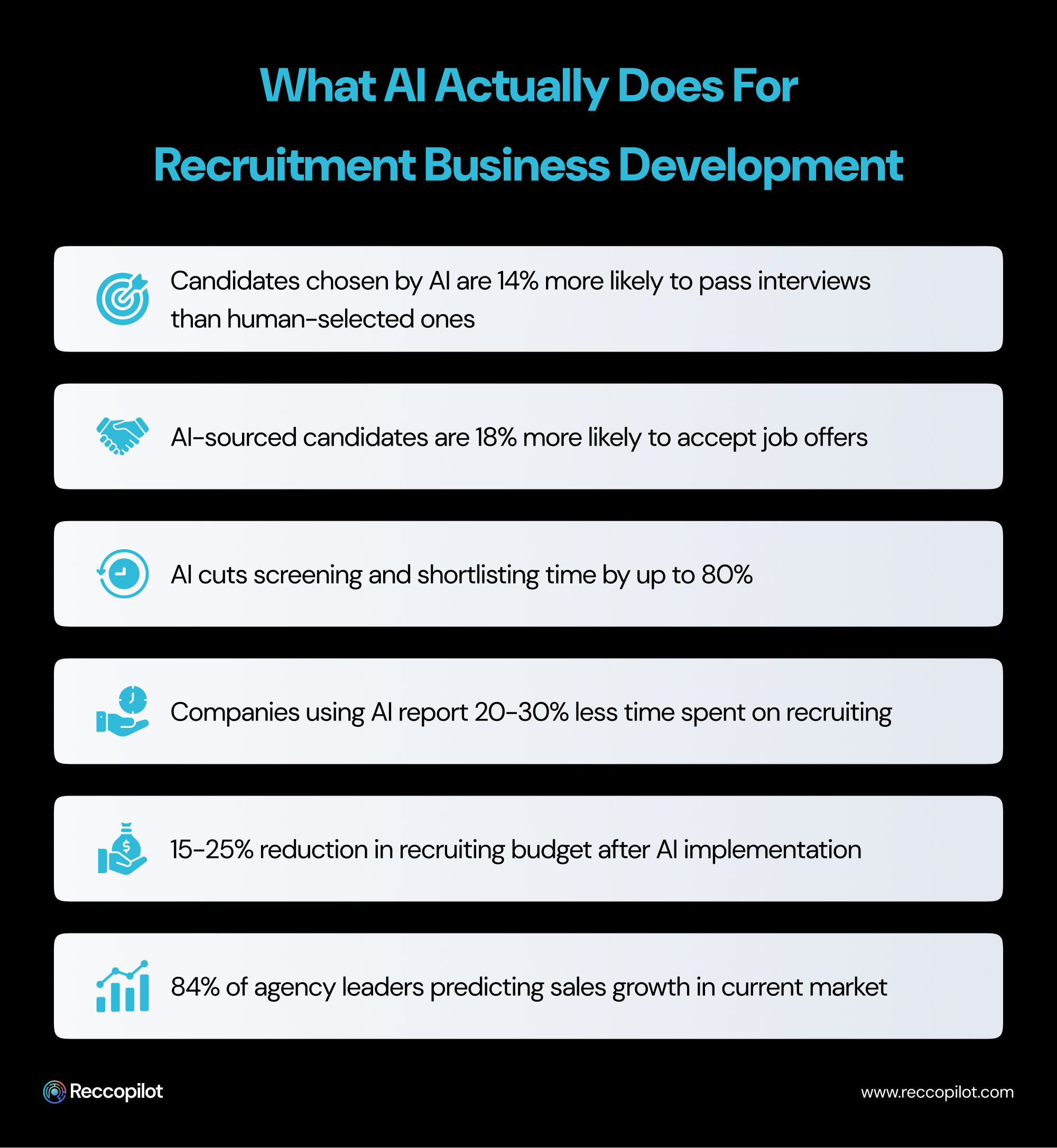
Platforms like Reccopilot offer AI-powered recruitment software that can be used to improve the agency’s sourcing, screening, and candidate matching processes. They can be integrated into the agency’s existing operations to supplement their current team, rather than replacing them. For agencies that want to see what such a system can do before committing to it, Reccopilot’s free trial can help them determine how it can benefit their business model without requiring any changes to their current operations.
Conduct a thorough assessment of the current state of the business and set growth targets for the next six to twelve months. Begin implementing the necessary changes and improvements to your applicant tracking system, as it is the foundation upon which the rest of the business will be built
Focus on building your expertise in two or three areas, and begin strengthening your digital presence. Make sure to dedicate resources to improving your client relationship management and retention
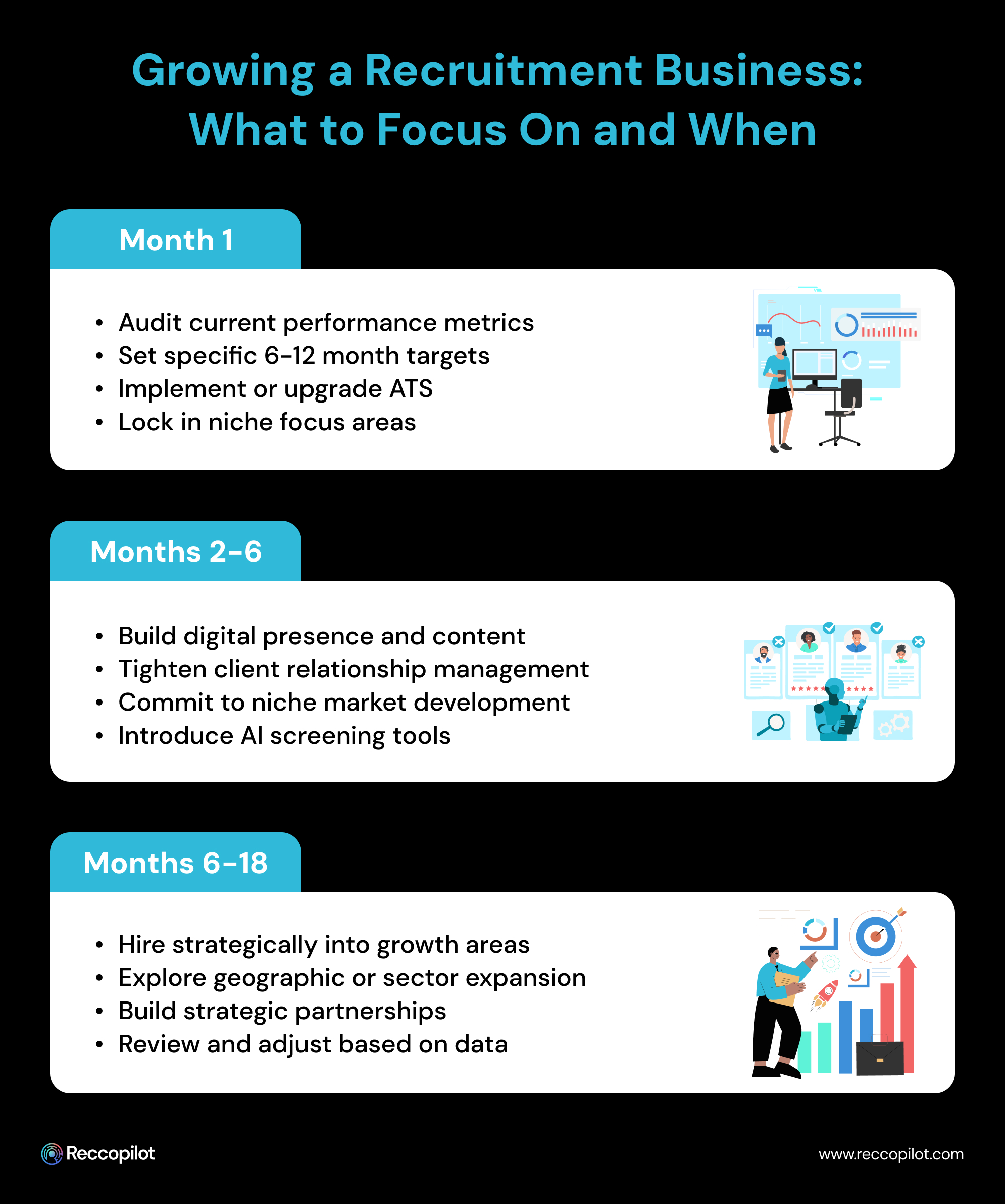
Begin hiring strategically in the areas you have chosen, and consider expansion, both in terms of geography and specialization, if the data supports it. Begin building partnerships with other agencies and third-party vendors that can help you serve your clients better
make sure to continue to measure and analyze the growth of your agency on an ongoing basis, and update your business plan as needed. The most important changes are usually made not at the beginning but at the end, when the original business plan no longer serves its purpose
Staffing agencies and recruitment companies will look very different in 2033 than they do today, as the market grows to be worth $2.29 trillion by 2033. The agencies that are set to benefit from this growth are the ones with a clear business plan, a defined niche, strong client relationships, and the tools to operate at scale.
A recruitment company business plan is not something that is set and then forgotten, it is a living document, updated and revised as needed. The agencies that survive and thrive, as opposed to simply existing, are the ones that understand this and update their business plan regularly.
Make sure to begin with a clear understanding of what you will specialize in and who your clients and candidates are, and then build the rest around it. Document and systematize everything, and use the right technology to scale your operations without sacrificing quality. Keep your human expertise, and use it to make the best possible decisions at every stage of the process.
That is the foundation of a proper business plan for a staffing agency, and the beginning of a long and successful career in the industry.




